


Abstract.
The overarching objective of the MFCBioFactory project is to develop and evaluate a microbial technology for the treatment and generation of electrical energy using wastewater from the canned food industry and to characterize electroactive (EAMs) and nonelectrochemically- active (non-EAMs) microorganisms involved in energy production and reduction using metagenomic sequencing and specific marker genes. A novel biofactory system that produces zero greenhouse gas (GHG) emissions, zero energy consumption, and allows the valorization of the generated waste, known as a microbial fuel cell (MFC) together with a photobioreactor (Microbial Fuel Cell Biofactory, MFCB) will be developed. The metagenomic microorganism characterization will be used to optimize the performance of the electrochemical biofactory system.
This project will allow the establishment for the first time of a circular economy in the biological treatment of industrial wastewater that is difficult to treat and has a high salinity, thus contributing to the UN Sustainable Development goals, Green Deal (MSCA Green Charter), and UN’s Sustainable Development Goals. The MFCBioFactory involves a multidisciplinary research team including researchers and industry professionals dedicated to process engineering, bioelectrochemistry, applied microbiology, and chemistry.
Research and innovation objectives
The overarching objective of the MFCBioFactory project is to develop and evaluate a microbial technology for the treatment and generation of electrical energy using wastewater from the canned food industry and to characterize electroactive (EAMs) and non-electrochemically-active (non-EAMs) microorganisms involved in energy production and reduction using metagenomic sequencing and specific marker genes. A novel biofactory system that produces zero greenhouse gas (GHG) emissions, zero energy consumption, and allows the valorisation of the generated waste, known as a microbial fuel cell (MFC) together with a photobioreactor (Microbial Fuel Cell Biofactory, MFCB) will be developed. The metagenomic microorganism characterization will be used to optimize the performance of the electrochemical biofactory system. This project will allow the establishment for the first time of circular economy in the biological treatment of industrial wastewater that is difficult to treat and has a high salinity, thus contributing to the UN Sustainable Development goals, Green Deal (MSCA Green Charter), and UN’s Sustainable Development Goals. The MFCBioFactory involves a multidisciplinary research team including researchers and industry professionals dedicated to process engineering, bioelectrochemistry, applied microbiology, and chemistry.


Some pictures of the novel technology of this project are shown.
Publications in research articles
Castellano-Hinojosa A, González-Martínez A, Pozo C, González-López J. 2022. Diversity of electroactive and non-electroactive microorganisms and their potential relationships in microbial electrochemical systems: A review. Journal of Water Process Engineering 50, 103199.
Castellano-Hinojosa A, Gallardo-Altamirano MJ, Pozo C, González-Martínez A, González-López J. 2024. Hydraulic retention time drives changes in energy production and the anodic microbiome of a microbial fuell cell (MFC). Journal of Water Process Engineering 59, 104966.
Castellano-Hinojosa A, Gallardo-Altamirano MJ, Pozo C, González-Martínez A, González-López J. 2025. Inoculum selection and hydraulic retention time impacts in a microbial fuel cell treating saline wastewater. Applied Microbiology and Biotechnology 109, 29.
Castellano-Hinojosa A, Gallardo-Altamirano MJ, Pozo C, González-Martínez A, González-López J. 2025. Salinity levels influence treatment performance and the activity of electroactive microorganisms in a microbial fuel cell system for wastewater treatment. Journal of Environmental Management 379, 124858.
Communication activities
Communication activity #1: Press Release in Digital Journals – UGR Divulga
-Means for communication used: Press releases and articles published in UGR Divulga, a platform dedicated to the dissemination of research from the University of Granada. The project’s key findings, breakthroughs, and future directions were presented in a way that appeals to a non-specialist audience.
-Target public(s): The general public, including students, local communities, and those interested in scientific advancements in wastewater treatment and renewable energy technologies.
-Main goal(s): To inform a wider audience about the significance of the project, raise awareness of its potential impact on environmental sustainability, and engage local and global stakeholders.
-Link: https://canal.ugr.es/noticia/proyecto-mfcbiofactory/
Communication activity #2: Press Release in Digital Journals – UGR
-Means for communication used: Press releases and articles published in UGR, the main website of the University of Granada. The project’s key findings, breakthroughs, and future directions were presented in a way that appeals to a non-specialist audience.
-Target public(s): The general public, including students, local communities, and those interested in scientific advancements in wastewater treatment and renewable energy technologies.
-Main goal(s): To inform a wider audience about the significance of the project, raise awareness of its potential impact on environmental sustainability, and engage local and global stakeholders.
-Link: https://www.ugr.es/universidad/noticias/mfcbiofactory-transformacion-aguas-residuales-energia-limpia
Communication activity #3: Press Release in Digital Journals – Ideal
-Means for communication used: Press releases and articles published in “Ideal”, a prominent digital newspaper specializing in regional news and current affairs in southern Spain. Key findings, breakthroughs, and future directions of the project were clearly presented and adapted to engage and inform a non-specialist audience effectively.
-Target public(s): The general public, including students, local communities, and those interested in scientific advancements in wastewater treatment and renewable energy technologies.
-Main goal(s): To inform a wider audience about the significance of the project, raise awareness of its potential impact on environmental sustainability, and engage local and global stakeholders.
Communication activity #4: Press Release in Digital Journals –El Independiente de Granada
-Means for communication used: Press releases and articles published in “El Independiente de Granada”, a prominent digital newspaper specializing in regional news and current affairs in southern Spain. Key findings, breakthroughs, and future directions of the project were clearly presented and adapted to engage and inform a non-specialist audience effectively.
-Target public(s): The general public, including students, local communities, and those interested in scientific advancements in wastewater treatment and renewable energy technologies.
-Main goal(s): To inform a wider audience about the significance of the project, raise awareness of its potential impact on environmental sustainability, and engage local and global stakeholders.
-Link: https://www.elindependientedegranada.es/economia/ugr-lidera-proyecto-mejorar-gestion-aguas-residuales-vez-que-generan-energia-electrica
Communication activity #5: Press Release in Digital Journals –El Debate
-Means for communication used: Press releases and articles published in “El Debate”, a prominent digital newspaper specializing in regional news and current affairs in Spain. Key findings, breakthroughs, and future directions of the project were clearly presented and adapted to engage and inform a non-specialist audience effectively.
-Target public(s): The general public, including students, local communities, and those interested in scientific advancements in wastewater treatment and renewable energy technologies.
-Main goal(s): To inform a wider audience about the significance of the project, raise awareness of its potential impact on environmental sustainability, and engage local and global stakeholders.
-Link: https://www.eldebate.com/espana/andalucia/20250328/investigadores-granadinos-convierten-aguas-residuales-fuente-energia-electrica-sostenible_282889.html
Communication activity #6: Press Release in Digital Journals – La Noción
-Means for communication used: Press releases and articles published in “El Debate”, a prominent digital newspaper specializing in regional news and current affairs in Spain. Key findings, breakthroughs, and future directions of the project were clearly presented and adapted to engage and inform a non-specialist audience effectively.
-Target public(s): The general public, including students, local communities, and those interested in scientific advancements in wastewater treatment and renewable energy technologies.
-Main goal(s): To inform a wider audience about the significance of the project, raise awareness of its potential impact on environmental sustainability, and engage local and global stakeholders.
-Link: https://www.lanocion.es/granada/20250327/investigadores-de-la-ugr-lideran-un-proyecto-para-7049.html
Contribution to International Conferences
Castellano-Hinojosa A, Gallardo-Altamirano MJ, Pozo C, González-Martínez A, González-López A, Marshall IPG. Presentación Oral. Salinity reduces the abundance and expression of genes involved in extra-cellular electron transfer in a MFC treating wastewater. 4th International Meeting Biochemical Foundation of Microbial Extracellular Electron Transfer, 22-23 Julio, Hamburgo, Alemania. 2024.
Castellano-Hinojosa A, Gallardo-Altamirano MJ, Pozo C, González-Martínez A, González-López J. Póster. Impact of hydraulic retention time on energy production and treatment of industrial saline wastewater using a microbial fuel cell system. 3rd International Meeting on New Strategies in Bioremediation/Restoration Processes, 29-30 Junio, Muttenz, Suiza. 2023.
Gallardo-Altamirano MJ, Castellano-Hinojosa A, Pozo C, González-Martínez A, González-López J. Póster. Microbial fuel cells for energy production and treatment of industrial saline wastewater: effect of hydraulic retention time. 6th IWA International Conference on Eco-Technologies for Wastewater Treatment, 26-29 Junio, Barcelona, España. 2023.
About the project
Dr. Antonio Castellano Hinojosa has been awarded a Marie Skłodowska-Curie postdoctoral fellowship under its European modality (Reference 101108081) through the HORIZON-MSCA-2022-PF-01 program (Horizon Europe, 2022). The fellowship supports his research on developing a biofactory for energy production and wastewater treatment in the canned food industry using a Microbial Fuel Cell system.
This project was also supported by the «R&D&I projects» grants for universities and public research institutions (Reference P20-00079) for the years 2021–2023, under the leadership of Principal Investigator Prof. Jesús González López.
Ongoing research
Research article: The fish-canning industry produces large volumes of wastewater rich in organic matter and salts. However, limited research has explored the valorization potential of this industrial wastewater using microbial fuel cell (MFC) technology operated in continuous flow mode. In this study, the hydraulic retention time (HRT) was found to influence voltage, current density, and power density in the MFC. Higher HRTs were associated with reduced efficiency in organic compound removal, an increased abundance of archaeal communities, and a greater relative abundance of methanogenic archaea, all contributing to limited energy production. Conversely, lower HRTs favored the relative abundance of electroactive microorganisms, enhancing energy production. These findings highlight the critical balance between HRT and the prokaryotic microorganisms responsible for organic matter removal and energy generation in an MFC treating fish-canning industry wastewater. This article has already been published in Applied Microbiology and Biotechnology.
Research article: There is growing interest in developing effective treatment technologies to mitigate the environmental impact of saline wastewater while also recovering valuable resources. However, how different salinity levels impact the diversity and composition of electroactive microorganisms in MFCs treating real effluents, such as urban wastewater, remained largely unexplored. This study investigated the impact of three salinity levels (3.5, 7, and 15 g/L NaCl) on current production, organic removal rates, and bacterial community dynamics in a continuous-flow microbial fuel cell (MFC) fed with urban wastewater. Using metagenomics and metatranscriptomics, variations in the abundance and expression of extracellular electron transfer (EET) genes and those involved in other general metabolisms were examined. The findings revealed that low salinity (3.5 g/L NaCl) enhanced both current production and organic removal efficiency compared to higher salinity levels. This enhancement was attributed to an increased abundance and activity of electroactive microorganisms, particularly taxa within the Ignavibacteria class, which harbor genes coding for outer membrane cytochromes and porin cytochromes. Additionally, salinity influenced general metabolic genes and microbial community composition, with higher salinity levels limiting bacterial growth and diversity. This study provided valuable insights into the interplay between salinity stress and microbial adaptation, contributing to optimizing MFC technologies for improved environmental and bioengineering applications. The article has already been published in Journal of Environmental Management.
Patent: We have a patent under review for a novel Microbial Fuel Cell Biofactory (MFCB) technology that integrates wastewater treatment with energy production and CO₂ fixation. The system uses the oxidation of organic matter in the anodic chamber to generate electricity, which powers microalgae cultivation in the cathodic chamber. The microalgae produce O₂ and fix CO₂, enabling efficient, cost-effective, and eco-friendly wastewater treatment with zero greenhouse gas emissions.
Reseach stays
Thanks to project 101108081 (Marie Skłodowska-Curie), Dr. Antonio Castellano-Hinojosa conducted a research stay at Aarhus University (Department of Biology) under the supervision of Prof. Ian P.G. Marshall. During this stay, he focused on characterizing the electroactive microbiome of MFC systems using metagenomic and metatranscriptomic techniques.
Dissemination activities

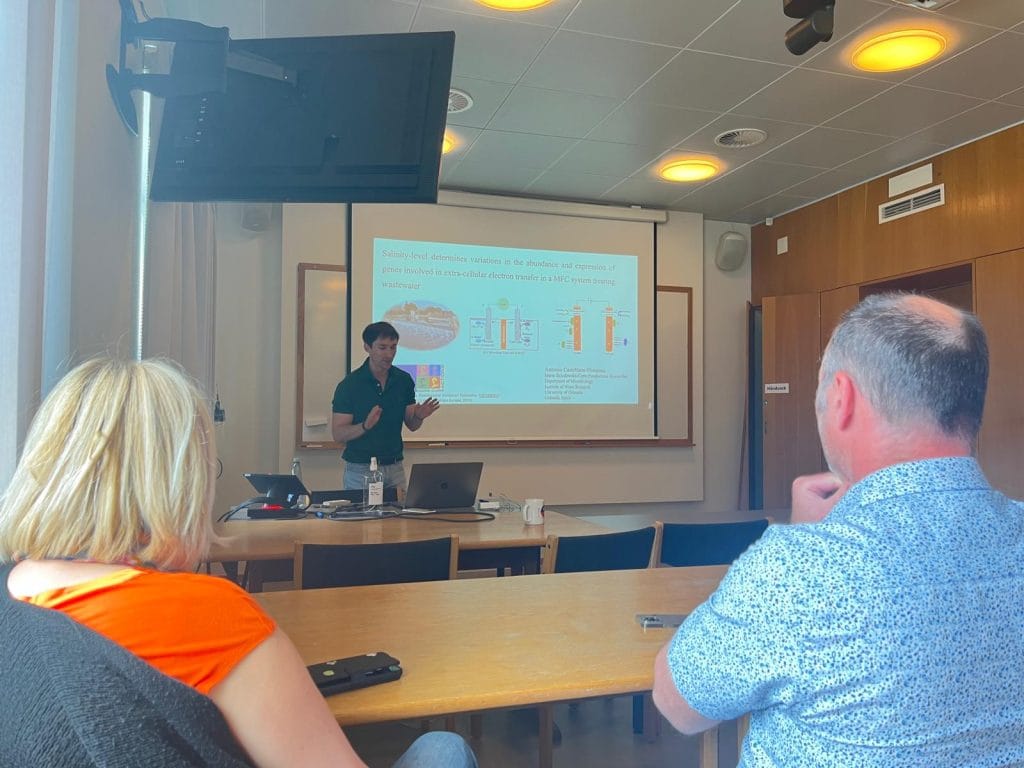


Social media:
Link/Platform: https://x.com/antonio_microUF
Throughout the course of the project, regular updates have been shared on my personal X account, providing real-time insights into the progress of the project and its key developments. This platform has been used to highlight important milestones, share outreach activities, and engage with the wider community. Posts have included updates on the experimental phase, significant findings, and other relevant events, helping to increase visibility and awareness of the project. Screenshots of the posts are attached to demonstrate the outreach efforts and engagement via this platform. In total, the posts have garnered over 2,000 views and several comments, fostering engagement and interaction.